

When a useful page loses rankings, rewriting it from scratch is rarely the best first move. A disciplined seo content refresh strategy helps you identify which pages are slipping, understand what changed, and make targeted improvements while protecting the value already earned through links, authority, and audience familiarity.
This guide lays out a repeatable process for diagnosing decline, choosing the right pages, updating content efficiently, and measuring results. The goal is not to change every old article. It is to make evidence-based updates where they can restore relevance and organic traffic.
1. Establish a reliable baseline before changing pages
A useful seo content refresh strategy starts with a trustworthy view of what is declining. Do not rely on a single traffic chart or a team member’s memory of when an article performed well. Gather page-level search data, analytics data, and the page’s current state before making edits. That baseline lets you separate a genuine search decline from seasonality, tracking changes, or a temporary business fluctuation.
Combine search and analytics evidence
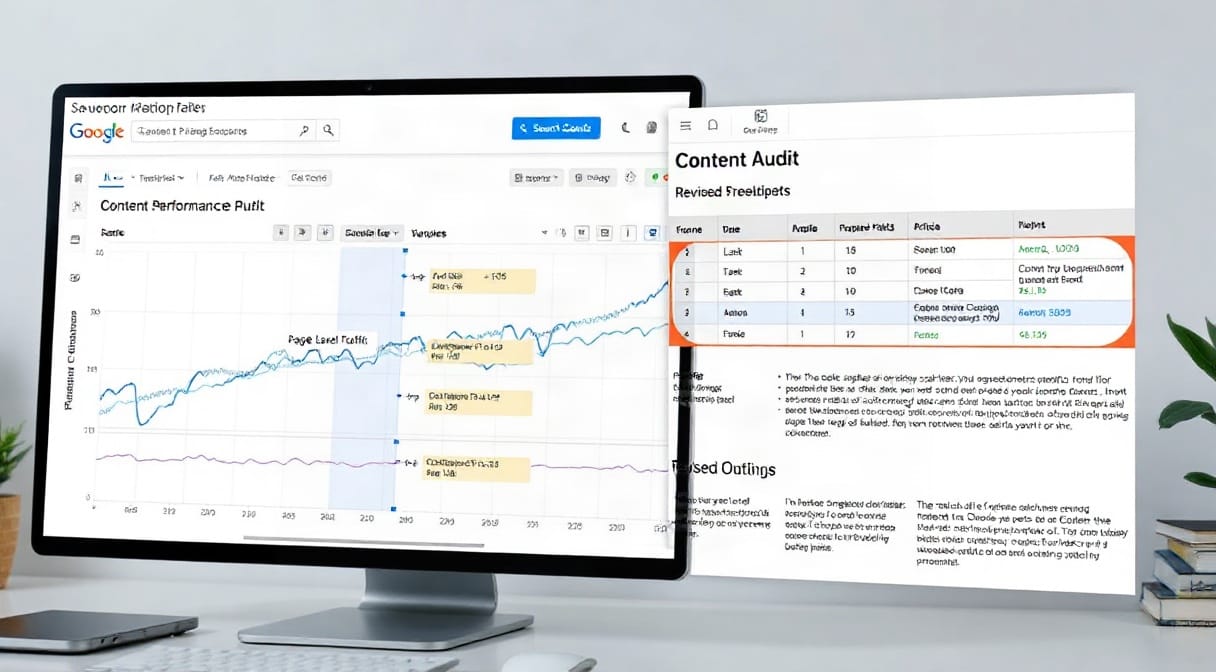
In Google Search Console, open the Performance report, choose Web search, and compare a recent period with the equivalent period from the previous year. Use the same date range where possible, and allow for reporting delays at the edges of the selected range. Export clicks, impressions, click-through rate, and average position by page and query. In analytics, compare organic sessions and meaningful outcomes such as leads, purchases, or engaged visits.
Each metric tells a different story. Falling impressions alongside weaker average positions can indicate lost visibility. Stable impressions with fewer clicks may point to a less compelling result snippet or a changed search results page. If clicks hold steady but conversions fall, the issue may be intent mismatch, an outdated offer, or a broken conversion path rather than content decay.
Use a spreadsheet to join page URLs to their titles, publication or last-review dates, organic sessions, conversions, backlinks, and primary queries. Search Console’s page and query exports reveal which terms lost impressions or position; analytics helps show whether the traffic mattered. A crawler can add status codes, canonical tags, indexability, title tags, headings, and word counts. These checks prevent you from treating a technical issue as a writing problem.
Confirm that the decline is real
Compare like with like. A seasonal guide may naturally fall after its peak, while a product page could be affected by inventory or changes to the site. Check whether a site migration, analytics consent update, robots directive, canonical change, internal-link change, or indexing issue coincided with the downturn. For technical symptoms, use the Search Console inspection workflow and review common indexability fixes for SEO pages before rewriting copy.
Look at a rolling trend rather than reacting to a few unusual days. A sustained decline over several weeks or months is more actionable than a short dip, although important seasonal pages deserve earlier attention. Annotate known site changes and major search updates in your working file so later comparisons have context.
Record the baseline and the date you collected it. Note the page’s leading queries, current position bands, click-through rate, organic conversions, and any known technical or commercial constraints. That snapshot makes the later evaluation meaningful and helps prevent a common mistake: calling an edit successful because rankings moved briefly, even when qualified traffic and business outcomes did not improve.
2. Choose pages with realistic recovery potential
A list of declining URLs is not yet a work plan. The next step in a seo content refresh strategy is to prioritize pages according to opportunity, confidence, effort, and risk. A page with a large historical audience is not automatically a good candidate: it may have lost demand, serve a query that has changed, or be superseded by a better page on your own site. Conversely, a modest page close to page one may be a practical improvement target.
Build a repeatable opportunity score
Start with a candidate set: pages that have meaningful historical organic value and show a sustained loss in clicks, impressions, rankings, or conversions. Filter out URLs with technical problems that should be fixed first, pages intentionally retired, and pages whose topic no longer supports your business. Then score the remaining URLs on a simple scale, such as one to five, across four dimensions:
- Opportunity: How much relevant traffic or business value has the page lost? Consider historical clicks and conversions, not just total sessions.
- Recoverability: Is the page still relevant, indexable, and aligned with a live search demand? Look for queries where it remains visible or ranks near the top of the results.
- Confidence: Do the data and search results suggest a clear reason for decline, such as missing information, an obsolete recommendation, or an intent mismatch?
- Effort and risk: Estimate the review, research, design, technical work, and potential disruption. A simple correction is easier to test than a full consolidation.
Multiply opportunity, recoverability, and confidence, then divide by effort if you want a quick ranking. This is a sorting aid, not a scientific prediction. Add a separate risk note for pages that earn links, drive conversions, or act as important entry points. A high-value page with uncertain intent may need a careful review before an edit, rather than a rushed rewrite.
Use intent and overlap to refine the list
Review the actual search results for the page’s main queries. A page may have fallen because searchers now expect a comparison, a step-by-step tutorial, a local result, or a product category rather than the format you publish. The guidance in search intent optimization playbooks can help you evaluate whether the page still answers the job behind the query.
Check for competing pages on your domain. If two URLs target the same need, compare their query overlap, links, conversions, and distinct value. Consolidation may be better than refreshing both, but only when the pages genuinely duplicate intent. Preserve useful material, choose the strongest destination, redirect retired duplicates appropriately, and update internal links. Do not merge pages simply because their topics share a word.
Finally, maintain a queue with a reason for every decision: refresh, monitor, consolidate, fix technically, or retire. Include the owner, estimated effort, expected outcome, confidence, and review date. This keeps the team from selecting pages based on the loudest stakeholder or the easiest article to edit. It also makes the seo content refresh strategy scalable: the same transparent criteria can guide a small editorial team or a large site with thousands of URLs.
3. Diagnose the cause before editing the article
Once a URL is selected, resist the urge to add words immediately. A successful refresh begins with a diagnosis, because the same symptom—fewer clicks—can have very different causes. The right seo content refresh strategy distinguishes between a content gap, a technical obstacle, a changed search result, and a drop in demand. The diagnosis determines whether you should revise, restructure, consolidate, repair, or leave the page alone.
Compare queries, competitors, and intent
In Search Console, compare the page’s query data across the baseline periods. Identify which query groups lost impressions, clicks, or average position, and note any terms that gained visibility. A page can have a stable overall average while losing its most valuable query, so inspect individual terms as well as the page summary. Separate branded queries from nonbranded ones and high-intent terms from informational searches.
Next, review the current search results for the important queries. Look at the page types that rank, the questions answered, the depth of coverage, and any prominent features such as video, product results, or discussion forums. Search layouts vary by query and location, so check the relevant market rather than assuming one result page represents every visitor. If the top results now solve a different task, update the format and scope to match the need—not to imitate competitors line by line.
Compare your page against those results for specific omissions. Perhaps the article gives a definition but no implementation steps; perhaps it recommends a process that no longer reflects current practice. Use a research brief to list the questions users need answered, the evidence supporting your claims, and the sections that deserve revision. The SEO content brief template offers a practical way to turn that research into an organized editorial plan.
Rule out technical and demand-related causes
Check the URL’s indexability, canonical, redirect chain, mobile rendering, page speed, and internal links. Confirm that the page returns the intended status code and that important content is available to search engines. If the page depends on JavaScript, review whether the rendered version contains its main content and links. A strong article cannot recover if search engines cannot access or understand it.
Then examine whether demand has changed. Google Trends can show relative interest over time for a topic, while Search Console impressions give evidence from your own site. Treat both as directional: trends data is normalized, and impressions depend on your visibility. A decline driven by fading demand may call for a smaller update, a new angle, or a decision to maintain rather than invest heavily.
Also inspect links and internal navigation. Lost external links, changes to related hubs, or a weakened internal-link path may reduce the signals and discovery that support a page. Check whether other pages on your site have begun answering the same queries. When overlap is the central issue, a structured topic cluster and site architecture review can help clarify which URL should serve each need.
Write a one-sentence diagnosis before changing anything: for example, “The page lost nonbranded clicks because the search results now favor actionable comparison guides, while our article remains a general overview.” That statement focuses the work and gives you a testable hypothesis. A careful seo content refresh strategy treats that diagnosis as a decision record, not a guess to retrofit after the update.
4. Refresh selectively while protecting what already works
The best update improves the page’s usefulness without erasing its established strengths. A targeted seo content refresh strategy starts from the existing URL, evidence, and audience needs. Before editing, preserve the original copy or use version history, record the page’s title and heading structure, and identify sections that still earn traffic, links, or conversions. This creates a safety net and helps reviewers see what changed.
Update facts, coverage, and structure
Review factual claims, examples, screenshots, statistics, product details, regulations, and recommendations. Verify each important claim against a reliable source or a subject-matter expert. Replace information that is demonstrably obsolete, and remove material that no longer serves the reader. An outdated content update should be more than changing a year in the heading: it should make the advice accurate for the reader’s present decision.
Then address the diagnosed content gaps. Add the missing steps, comparisons, limitations, definitions, or examples that help complete the task. Explain trade-offs and exceptions, not just the ideal scenario. If search results indicate that users want a clear process, include a sequence they can follow; if they need a decision, make the criteria easy to compare. Add depth where evidence calls for it, not by padding the article to match an arbitrary word count.
Organize the revised article so the most useful answer appears early. Use descriptive headings, concise paragraphs, and lists for steps or criteria. Check that the introduction sets the right expectation and that each section contributes a distinct answer. Improve clarity and accessibility, including meaningful link text and useful image descriptions. A page that is easier to scan can serve readers better without sacrificing detail.
Preserve relevance, links, and conversion paths
Keep the URL stable unless there is a compelling technical or structural reason to change it. Retain sections that still satisfy valuable queries, and avoid deleting unique information solely because it is not prominent in a competitor’s article. When revising a title or description, make the promise accurate and specific; do not force a keyword into awkward copy or imply results the page cannot deliver.
Review internal links in both directions. Add contextual links from relevant, strong pages where they help readers discover the updated resource, and ensure the refreshed page links to useful next steps. Check links to sources and destinations for accuracy. If an update changes a recommendation or process, confirm that any linked templates, tools, and related articles still support it.
For an outdated content update, be transparent where the publication or review history is shown, and update dates only when a substantive review warrants it. A date change by itself is not an editorial improvement. Consider whether structured data still accurately describes the page, but do not expect markup alone to restore rankings. The page must deliver useful, trustworthy information that matches the searcher’s need.
Before publishing, ask an editor or subject expert to verify claims, check the page on mobile, test key links and calls to action, and compare the rendered page with the intended content. Log the exact changes, the diagnosis, and the expected outcome. That record makes the experiment interpretable if results shift. It also keeps a careful update from turning into an uncontrolled redesign that changes content, templates, and tracking all at once.
5. Measure recovery and build a durable operating process
Publishing is the start of measurement, not proof of success. The final stage of a seo content refresh strategy is to check whether the page improved against its original problem and whether the change helped the intended audience. Rankings can fluctuate, and one strong week is not enough to establish a lasting recovery. Use the baseline you saved, review the relevant query groups, and judge performance over a period appropriate to the page’s traffic and seasonality.
Track leading and business outcomes
Annotate the update date in your editorial log and, where your analytics workflow supports it, in your reporting notes. Monitor Search Console clicks, impressions, average position, and click-through rate for the URL and its target queries. In analytics, examine organic sessions, engaged visits, and the conversion events that matter. Use the same comparison method as before the edit, and account for seasonality or other site changes that could influence results.
Separate early signals from final outcomes. Search engines may need time to recrawl and reassess a page, so check indexing and rendering first if nothing appears to change. Later, look for a sustained improvement in visibility and qualified traffic. If impressions rise but clicks do not, inspect the result presentation and query mix. If traffic returns but conversions do not, revisit intent, the offer, and the page’s next-step experience.
Set a review cadence based on traffic volume and business importance rather than a universal deadline. A high-traffic commercial page merits closer monitoring than a low-volume evergreen resource. Compare against both the period immediately before the update and a suitable year-over-year period when seasonality matters. Do not change the page repeatedly in response to noisy daily data; overlapping edits make it difficult to learn which intervention mattered.
Turn results into a repeatable content program
Classify each completed update as recovered, partially improved, unchanged, or declined, and add a short explanation. For a successful page, identify what likely helped: filling a specific gap, correcting intent, restoring internal links, or fixing access. For an unsuccessful one, revisit the diagnosis before making another major change. Consider whether demand has faded, the page belongs in a different format, or a technical issue remains.
A lightweight editorial calendar can include the URL, owner, diagnosis, action, effort, baseline, target queries, publish date, and review date. Assign subject-matter reviewers for topics where accuracy has real consequences. Keep separate queues for routine maintenance, strategic refreshes, technical fixes, and consolidation decisions. This prevents all aging pages from being treated as emergencies and allows effort to follow expected value.
Use the results to refine your selection scores. If pages with strong recoverability consistently improve, give that signal more weight. If updates based only on age rarely help, remove age as a primary trigger. The goal of content decay recovery is not to refresh a fixed number of pages each month; it is to restore useful performance where the evidence supports an intervention and to stop investing where it does not.
For teams managing many URLs, sample the queue regularly and look for patterns by template, topic, or intent. A cluster of declines may point to one sitewide issue, such as weakened internal links or a rendering change, rather than dozens of unrelated content problems. Resolve shared causes at the right level, then reassess individual pages. This makes the work more efficient and reduces the risk of repeatedly editing symptoms while the underlying cause remains.
Make the process visible to writers, editors, analysts, and technical colleagues. A short decision log and clear ownership encourage consistent judgments even when team members change. Keep the original baseline and version history so future reviews can distinguish a genuine content improvement from unrelated ranking movement. Over time, this turns an occasional seo content refresh strategy project into a practical maintenance system that protects the value of your existing library.
For further reading, see Google Search Central.
For further reading, see the Moz SEO learning centre.
FAQ
How often should I refresh an article?
Refresh a page when evidence indicates that its facts, usefulness, search intent, or performance need attention-not just because it has reached a certain age. Set a routine review schedule for important pages, but use Search Console, analytics, user feedback, and subject-matter changes to decide whether an edit is warranted. High-impact pages may need more frequent review than low-demand resources.
Should I change the URL when updating content?
Usually, keep the existing URL so you preserve its established history, links, and internal references. Change it only when there is a clear reason, such as a necessary restructuring or an incorrect URL that creates a lasting problem. If you do change it, implement an appropriate permanent redirect, update internal links and sitemaps, and monitor indexing and traffic.
How long does content decay recovery take?
There is no fixed recovery period. Crawling, competition, demand, site authority, and the size of the change all affect how quickly results may appear. Confirm that the updated page is accessible and indexed, then monitor relevant queries and outcomes over a suitable period. Avoid promising a ranking recovery date; assess sustained trends rather than isolated movements.
What is the first step in a seo content refresh strategy?
Establish a reliable baseline and verify the decline before editing. Compare Search Console query and page data with analytics outcomes, then check technical accessibility, seasonality, intent, and current search results. The first useful action is a clear diagnosis. That helps you choose an appropriate outdated content update—or decide that the page needs a technical fix, consolidation, or no change.
Conclusion: Recover value with evidence-led updates
A steady process helps you find pages that are truly declining, identify why they lost visibility, and choose changes with a reasonable chance of helping. Start with a verified baseline, prioritize by opportunity and effort, diagnose before editing, protect what still works, and evaluate outcomes against the original problem. Not every page will recover, and not every decline deserves a rewrite.
Use this seo content refresh strategy to improve your existing library without starting from scratch. Begin with a small group of high-confidence pages, document what you change, and use the results to make the next decisions smarter. For more practical SEO guidance and resources, visit GlobalSEOFlow.